
- HOME
- Careers
- Researchers' Voices
- Lifting Up a New Generation of Chemists: Min Gao at WPI-ICReDD
Lifting Up a New Generation of Chemists: Min Gao at WPI-ICReDD
Jun 3, 2026
Lifting Up a New Generation of Chemists: Min Gao at WPI-ICReDD
Min Gao is a junior PI at the Hokkaido University Institute for Chemical Reaction Design and Discovery (WPI-ICReDD), a WPI center pursuing a vision of custom-crafted chemical reactions to create a more sustainable and prosperous future for humanity. Her research focuses on mechanistic studies of both homogeneous and heterogeneous catalytic systems using automated reaction path exploration methods such as GRRM and AFIR combined with quantum chemical calculations. Recently, she contributed NNP/AFIR-assisted reaction path search to predict enantioselectivity in catalytic reactions.
Gao’s work in computational chemistry is contributing by pushing the boundaries of virtual reaction simulation and prediction, reducing the need for costly and hazardous experiments. Gao spoke to us about how WPI-ICReDD supports her work through high-performance computing resources, administrative and research support, funding, management guidance, and collaborative networks, as well as her role in raising the profile of up-and-coming and particularly female researchers at the center.
Note: Interviewed in February 2026. Positions and titles are current as of the time of the interview.

Min Gao, junior PI at the Hokkaido University Institute for Chemical Reaction Design and Discovery (WPI-ICReDD), standing among the center’s supercomputers.
Inspired by Glimpses of a Better World
Chemical reactions are essential to human civilization and prosperity. As new environmental and societal challenges arise, developing new chemical reactions will play an integral role in addressing them. WPI-ICReDD’s goal is to renew the way chemical reactions are developed by fusing computational science, information science, and experimental science to solve current and future problems faced by humanity. One key piece of the puzzle is Gao’s field of computational chemistry.
“With computational chemistry, instead of running physical experiments, you can input molecular structures into a computer and predict reaction outcomes, including selectivity and yield,” says Gao. “I still remember the day I first met my master’s supervisor. On his computer, he showed me Suzuki-Miyaura Cross-Coupling Reaction transition states for the first time—it allowed me to directly observe how atoms form bonds at the microscopic level.”
This experience led Gao to pursue research in computational chemistry. She was inspired by the work of theoretical and computational chemists, MOROKUMA Keiji and SAKAKI Shigeyoshi. She came to Japan and joined Hokkaido University in 2009 as a Ph.D. student. Following two years of postdoctoral research, she became an assistant professor at Graduate School of Science and later moved to Institute for Catalysis (ICAT) in 2018 at Hokkaido University. In 2022, she saw that WPI-ICReDD was recruiting for a tenure-track junior PI position.
“They were looking for someone to do ‘fusion research,’ combining computation, informatics, and experimental science,” says Gao. “It sounded perfect for me.” WPI-ICReDD was already recognized in its field, she adds, as its director MAEDA Satoshi’s group has made significant contributions to retrosynthetic synthesis of organic reactions without relying on prior assumptions, through the construction of reaction path networks using the artificial force induced reaction (AFIR) method. Gao won the post, and now leads a research group at WPI-ICReDD.
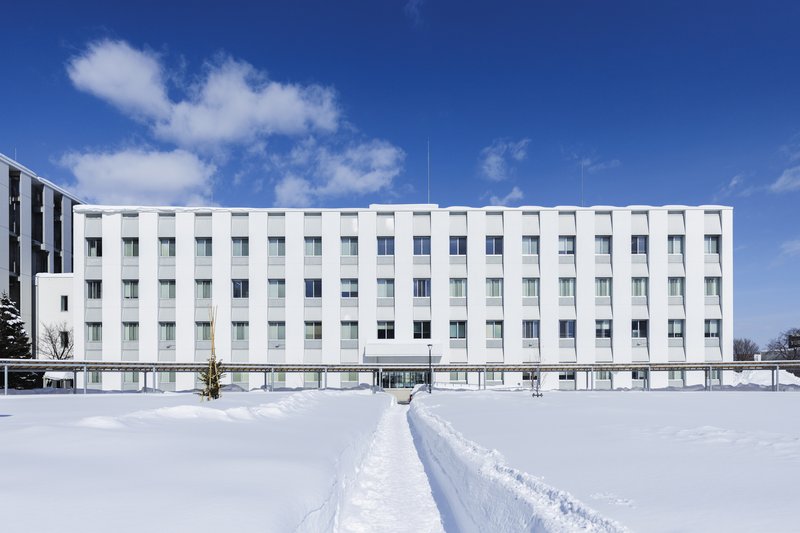
The WPI-ICReDD building, completed in 2023.
Technical and Administrative Support to Unlock Potential
WPI-ICReDD offers extensive support to junior and senior PIs, including equipment, research funding, and administrative coordination. “In computational chemistry, our main tool is the computer, and WPI-ICReDD has a lot of computing power,” says Gao. “Supercomputers are expensive and require special facilities with reinforced floors and cooling systems. At WPI-ICReDD, we can all access them whenever we need them.” This environment, together with strong administrative support, allows Gao to focus on her research without being burdened by technical or logistical constraints.
Gao also highlights the extensive support provided by the administrative office—including general affairs (e.g., personnel matters), accounting (e.g., guidance on the proper use of research funds), public relations (PR; e.g., outreach and conference organization), and research coordination (support for research activities)—all of which have been essential to her research activities.
To support researchers in initiating interdisciplinary “fusion research” across its three core fields, WPI-ICReDD offers “Fusion Research Start-up” support for selected projects. It also has a dedicated “Fusion Research Coordinator”, HARABUCHI Yu, who actively promotes collaboration across different research areas within the center. Junior PIs at WPI-ICReDD are supported by a two-advisor system, who provide guidance on both research and management. In addition, Gao’s group holds regular discussions with the Research Administrative Director, YAMAMOTO Yasunori, through which they receive valuable research advice and insights related to organometallic reactions. Senior PIs also provide guidance and support for external grant applications. As a result, many researchers at WPI-ICReDD successfully secure competitive funding, creating further opportunities for their research and career development.
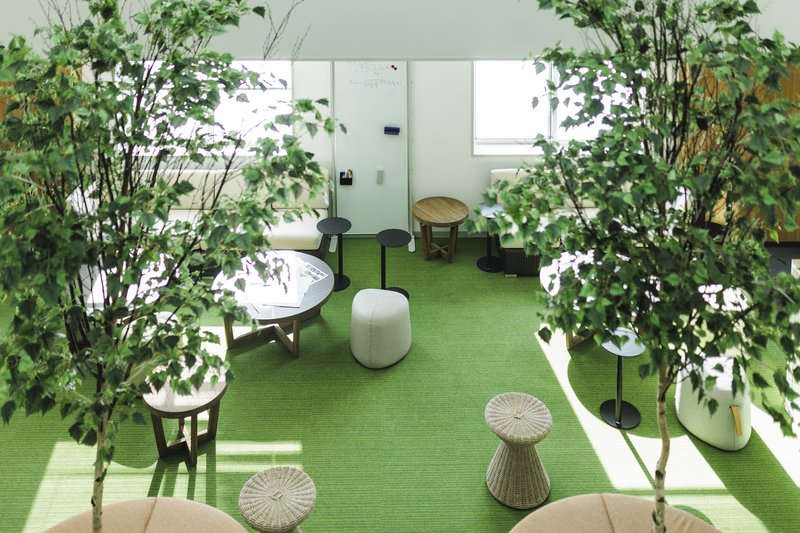
At the center of the WPI-ICReDD building is an atrium that gradually and seamlessly blends into spaces for office work and experimental laboratories on either side. This creates a welcoming environment conducive to interdisciplinary research.
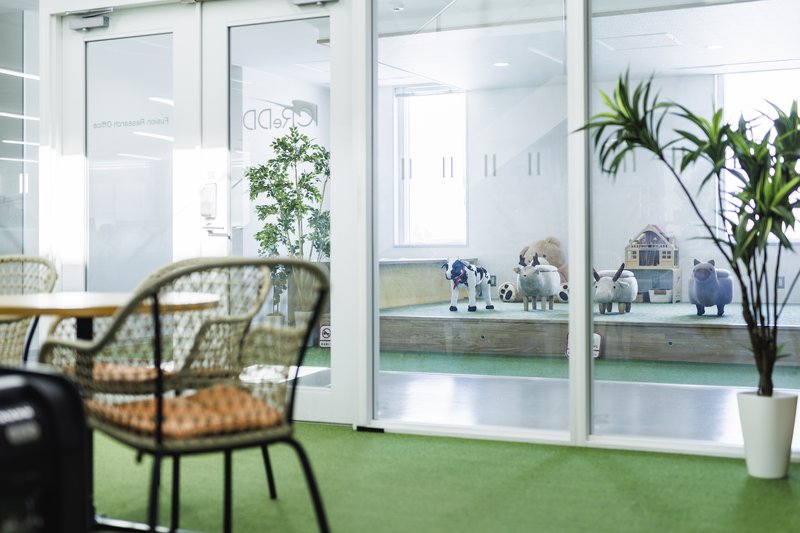
The lounge next to the atrium also has a children’s play area.
Paralleling these formal support structures, WPI-ICReDD is designed from the ground up for informal collaboration. “The Mix Office on the second floor has experimental researchers at one end, computational and informatics researchers at the other, and a space in the middle for mingling,” says Gao. “If you want to talk to someone, you can just go to their desk, no appointment needed. It’s very supportive.”
WPI-ICReDD also provides comprehensive support programs to help international researchers settle in smoothly. English is the working language, and the center’s “hospitality system” helps newly arrived researchers find apartments and deal with bureaucratic procedures outside the center. This support allows researchers to transition quickly and focus on their work from an early stage. Free Japanese classes are available, as are seminars on functioning in professional Japanese settings.
“There are also ‘get-together’ events at WPI-ICReDD almost every month, organized by Ms. Carine Seraphim and Dr. Ruben Staub and Dr. HARABUCHI Yu,” says Gao. “All members are welcome to attend, and you can bring your friends and family, too. It’s a nice way to get to know your colleagues in a relaxed setting.”

“I want students and lab members to enjoy doing research,” says Gao. She works to create an environment where members can pursue research with curiosity and enjoyment, while developing their own ideas and confidence.
Organizing Events to Highlight Up-and-Coming and Female Researchers
Gao has also seized the opportunities at WPI-ICReDD to gain experience organizing seminars and conferences. One common theme in the events she organizes is a strong female presence, recruited through the extensive network she has built up. This approach aligns with WPI-ICReDD’s emphasis on diversity and interdisciplinary collaboration, as well as her own belief in the importance of increasing the visibility of female researchers. “We want to increase the visibility of female researchers, so that young female students realize that it’s a viable career path for them,” says Gao.
WPI-ICReDD’s presence at the Hokkaido University Festival, offering fun science experiences such as slime-making for children, was made possible with continuous support from the administrative office’s Public Relations (PR) team, SUZUKI Mio, to which Gao and her laboratory also contributed. In 2024, Gao was also instrumental in adding the Rising Star Program to the center’s 8th international symposium, again with substantial support from the PR team. She sent out a call for posters and funded travel to the symposium for the most promising respondents, including one presenter from Thailand. The result was the largest poster session in the symposium’s history, with 52 presenters. The following year, for the 2025 symposium, she built on these efforts by adding a Structural Re-Programming (SReP) session, again supported by the PR team, in which more than half of presentations were given by early career female researchers.
“A senior PI needs to be able to organize a conference, so WPI-ICReDD actively supports its members in developing these skills,” says Gao. “In the same spirit, they also offer assistance to new junior PIs learning to run a lab for the first time. WPI-ICReDD is a great place to gain these essential skills for an academic career.”
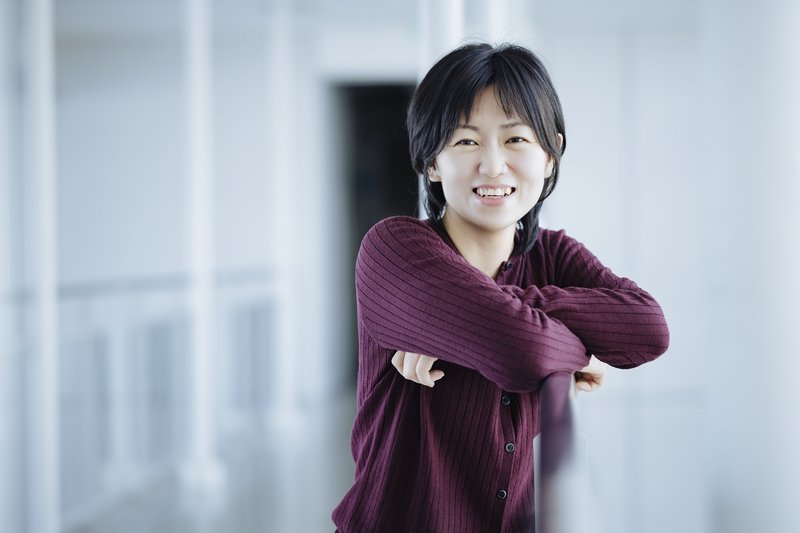
Gao’s closing message to international researchers is simple: “If there’s a WPI center in a field close to yours, and you want to do research in Japan, just join! The support available here makes the WPI network the best starting point as an international researcher in Japan. By contributing to the center’s mission, you can address important scientific challenges and contribute to solving real-world problems while growing as a researcher.”
Min Gao
Ph.D., Science, Hokkaido University (2012)Postdoctoral Fellow, Quantum Chemistry Lab, Department of Chemistry, Faculty of Science, Hokkaido University (2012–2015)
Assistant Professor, Quantum Chemistry Lab, Department of Chemistry, Faculty of Science, Hokkaido University (2016–2018)
Assistant Professor, Catalysis Theory Research Division, ICAT, Hokkaido University (2018–2022)
Associate Professor, WPI-ICReDD, Hokkaido University (2022–)
Gao Group’s HP: https://sites.google.com/view/ccc-lab